
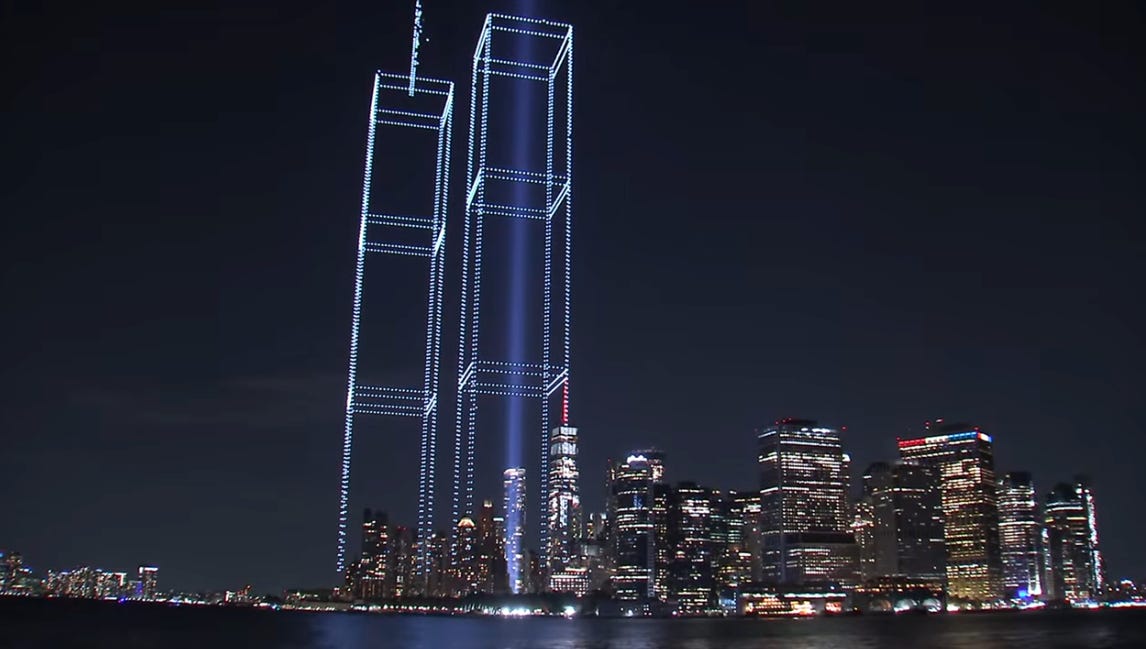
I was 700 miles from the World Trade Center on the morning of Sept. 11, 2001, but what happened there changed my life. That’s the story for many Americans still alive today, reflecting on the attacks 25 years ago on New York, Washington, D.C., and Pennsylvania that claimed the lives of 2,977 people, most of them civilians from 38 states and 70 countries.
I had spent the previous year mostly covering a raging war inside Sudan, making repeat trips to the border areas between northern and southern Sudan (before they became separate countries), seeing up close what happened when radical Islamic groups took on Muslim and Christian populations in the south.
I saw young men maimed by landmines and watched a 3-year-old in her last hours before she died of starvation. I met the heroes who worked the hospitals and opened the school doors even as the Khartoum government dropped bombs on their sites. I joined the clutches of worshippers gathered under shade trees to sing under open sky after their churches and homes had been burned.
On a trip in 2000, a veteran aid worker handed me Yossef Bodansky’s new biography of a man named Osama bin Laden, and I read it on the plane ride to Africa. In Sudan days later, we skirted an al-Qaeda training camp, abandoned by bin Laden and his followers four years before when they left for Afghanistan. Returning to the States, I met with editors and colleagues to discuss the growing threat Islamic extremism posed across Africa, even as Mohamed Atta and other hijackers already were enrolling in flight schools in the United States.
For those who remember, the day will stand out for starting cloudless and brilliantly sunny along the Eastern seaboard. Millions of Americans were on their way to work, and in New York City it was the first day of school and a primary election day. An ordinary day until a message from the cockpit of American Airlines Flight 11 reached air traffic controllers: “We have some planes. Just stay quiet and you will be OK.”
I had no expertise in terrorism and little experience in the Middle East, but after 9/11 these became my full-time focus. I traveled several times to New York and began to meet families of victims of the attacks. I interviewed firefighters, engineers, and pastors during visits to the still-smoldering destruction at Ground Zero. In the spring of 2002 I made a trip to Syria and Lebanon as leading Christian and Muslim clergy came together to discuss the aftermath, meetings that at several points turned into shouting matches among the clergy, so raw were the tensions still. I made my first foray to Iraq then, too, climbing into an outboard motorboat to cross from Syria with the help of its military intelligence service. I couldn’t know then that it would be the first of many trips to Iraq over the next 18 years. The wars in Afghanistan, Iraq, and Syria absorbed me into the wider region, and I would learn that what we think of as the “Arab world” or “Muslim world” is in fact a diverse multi-ethnic, multi-faith landscape.
At a time when many Muslims and Middle Easterners faced scrutiny and rejection in the United States, I was welcomed into the homes of Iraqis, Syrians, Israelis, Jordanians, and Lebanese (and wrote a book about some of them in 2016). War on the political level as told in U.S. headlines, I learned, was different from war lived at the street level among ordinary people. The civilians who lost their lives on 9/11 would be followed by more than 7,000 U.S. military personnel plus hundreds of thousands of civilians in Iraq, Afghanistan, Pakistan, and Syria killed in the global war on terror.
My life and work as a reporter, and my family’s life too, would be changed by the many examples of resilience and bravery we saw on 9/11 (here from a piece on the 10th anniversary)—
Bruno Dellinger, who worked on the 47th floor of the North Tower, headed down an overheated stairwell. He discovered “regular people, like me, and people from upper floors who were badly burned-no skin, no hair, just burned-they were coming down, walking or carried down helped by people.” He met firefighters and security personnel: “In some of those eyes you could see that they knew something, it was dangerous, they knew something . . . and while there was no panic whatsoever in the stairwell, those people were concentrated, focused on doing their job . . . and while I was walking down they were going up to their death, and I was walking down to live.”
As the war years ground on, I saw Afghans and Iraqis who had welcomed U.S. military offensives grow distrustful of American presence and embittered by unending and unfocused wars. A quarter-century later, many of us reach this anniversary with mixed feelings. Gratitude that the attacks of that Tuesday have not been repeated but remorse over the ways threats and war have become our constant companions since. The way even now we are locked in an escalating war in the Middle East by a president who campaigned to take the country out of forever wars. The fallout of that day and learning the lessons of 9/11 are still very much with us.
“Fear is a legitimate emotion. It is a terrible operating system for a republic,” writes war veteran Shawn VanDiver, now president of #AfghanEvac. His own account of the post-9/11 costs is worth your time.
The attacks of 9/11 consumed U.S. resources and attention, in ways that contributed to the rise of China and an increasingly hostile Russia, writes the former foreign editor of The Wall Street Journal.
Former President George W. Bush in rare remarks on Wednesday called out U.S. isolationism. His full discussion with former Secretary of State Condoleezza Rice revisiting events around 9/11 is here.
C-Span will carry live 9/11 commemorations in lower Manhattan today, at the Pentagon, and Shanksville, Pa.
American Ground by William Langewiesche remains a seminal book on “unbuilding the World Trade Center.” One of the most incisive writers on 9/11 and all that came after, he died last year of cancer but his archive is a trove for those who weren’t born then or want to learn about it.
UPDATE: A Langewiesche postscript about the book and the recovery work posted today (9/11) by The Atlantic is a better entree to his other work. Gift link here.
Capturing Khalid Sheikh Mohammed, the 9/11 mastermind and number-three al-Qaeda leader, took 18 months. Bringing him to justice has taken more than 20 years, but a military judge has announced a new date for his trial, June 5, 2028. Prosecutors notified 9/11 families last week they will not appeal to reinstate KSM’s confession made to FBI agents at Guantanamo in 2007, which earlier had been dismissed as evidence because he was subjected to waterboarding. Prosecutors have amassed other evidence to convict him and three co-defendants, which could lead to the death penalty.
The context and consequences you describe sharpen our focus as we remember a day and the days and years that followed. Thank you.
Love these glimpses into your work from long ago.