Institutional sabotage?
In place of diplomats accountable to Congress, Trump is not so much reforming the State Department as replacing it with his own monied cadre. And other news.

Eighteen months into President Donald Trump’s second term, more than half of all U.S. ambassadorships are vacant (107 out of 195 as of late June), with no candidates yet named or nominated for the posts. They include high-status and high-stakes posts like Saudi Arabia, Ukraine, Russia, Iraq, Pakistan, Sudan, and Venezuela.
Across Africa, 41 countries are without a top U.S. envoy, or nearly 80 percent of the continent. The administration recalled more than a dozen career ambassadors from Africa in December without replacing them, a move the American Foreign Service Association called “institutional sabotage.” While U.S. presidents typically name political appointees to high visibility posts like London or Tokyo, less enticing posts in Africa are often filled by career diplomats.
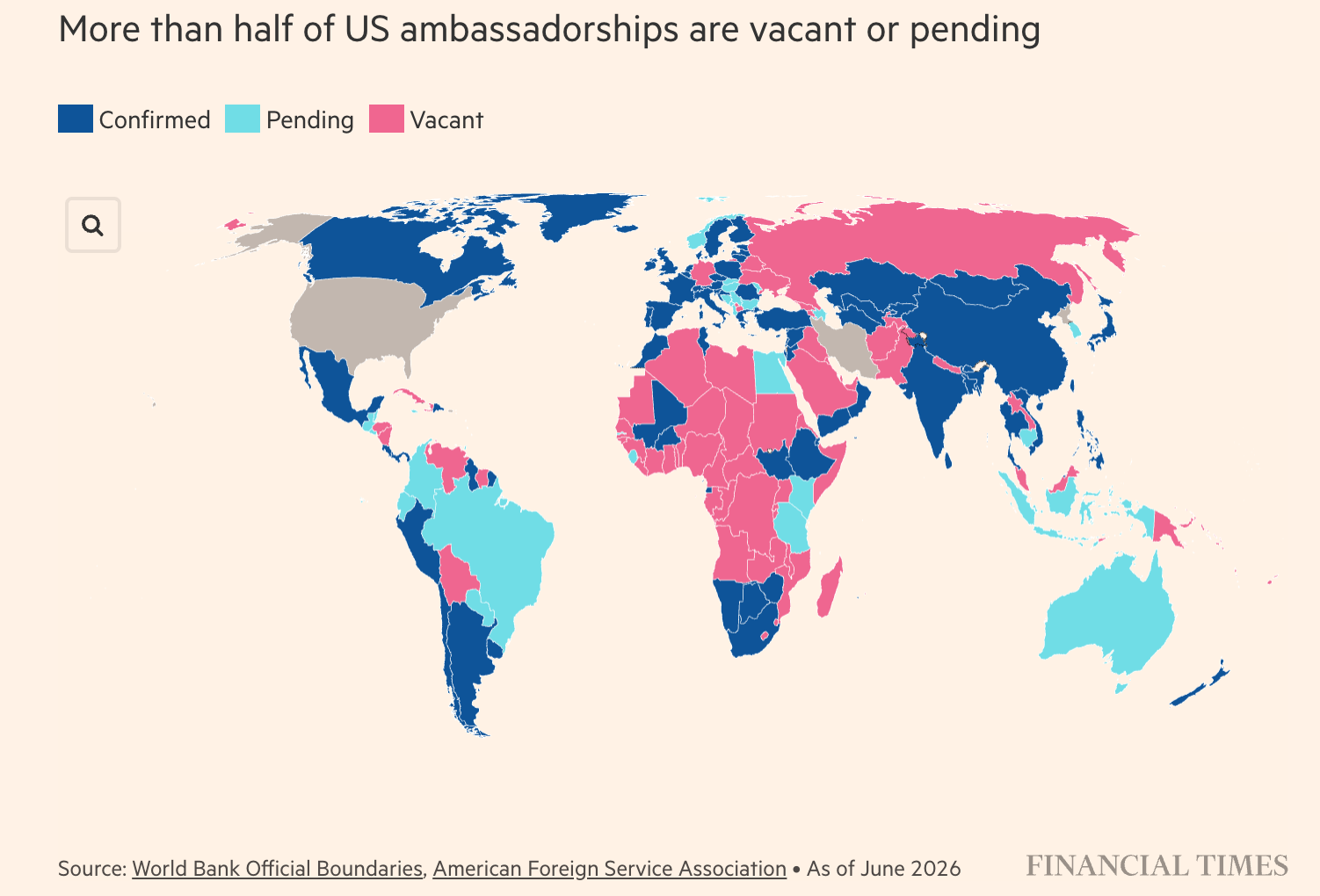
Across the board, the vacancies are part of overdue reforms for an out-of-touch U.S. State Department, say administration officials, a shakeup initiated by Trump along with foreign aid cuts the day he took office last year.
But former top officials speaking to the UK’s Financial Times say the absences are depriving the U.S. of needed expertise and making it harder to achieve foreign policy and national security objectives. The United States’ escalating war with Iran after an unworkable ceasefire agreement is the latest example. The failure-to-launch of Trump’s Board of Peace in Gaza is another.
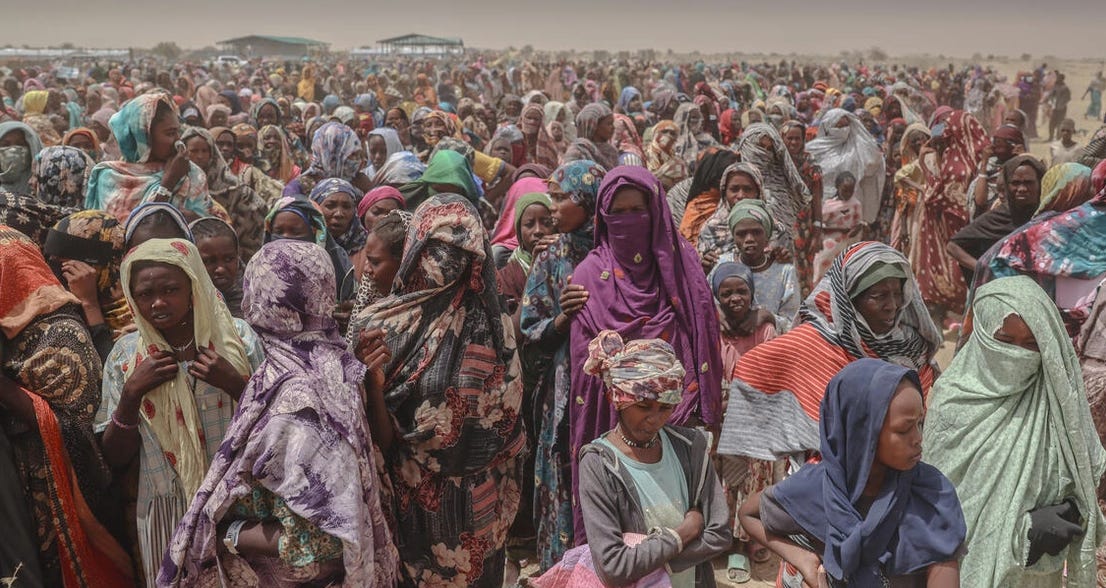
The vacancies in Africa include Chad and Sudan, where war has spawned the largest concentration of refugees in the world; and Democratic Republic of the Congo, where an Ebola outbreak is outpacing response while a U.S.-supervised peace accord stalls.
In South America, Secretary of State Marco Rubio was tapped to lead the transition and recovery in Venezuela after U.S. forces captured President Nicolás Maduro. Rubio has yet to travel there. The country has no U.S. ambassador even as the United States is supporting a massive disaster recovery effort following June earthquakes.
In place of diplomats accountable to Congress, Trump is not so much reforming the State Department as replacing it with his own political cadre, relying on business friends and donors to mediate foreign policy.
“The president and his allies have built a network of groups financed by wealthy donors and businesses that is advancing his priorities with little public disclosure,” reports The Wall Street Journal in documenting (gift link) almost $1 billion in donations to Trump-linked groups since the 2024 election.
How does it play out overseas? Here’s one under-the-radar example:
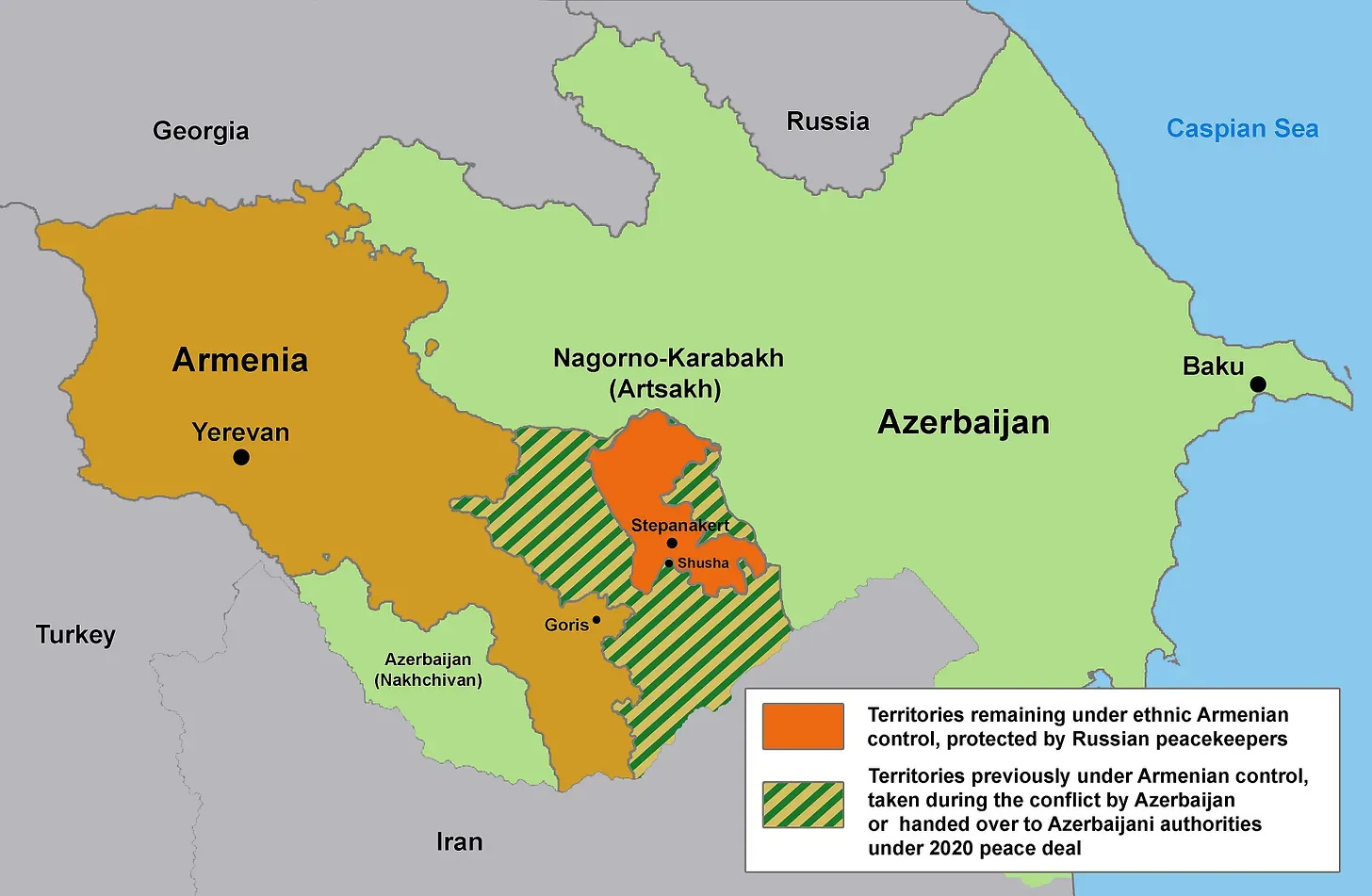
In August 2025, the United States brokered a peace agreement between Armenia and Azerbaijan, signed at the White House. It appeared to be the most significant step towards normalizing relations between the two countries following decades of fighting over the disputed territory of Nagorno-Karabakh (also called Artsakh or Karabakh). The now-defeated Armenian Christian enclave sits inside Muslim Azerbaijan, and at the heart a long ignored land bridge connecting the Caspian Sea to the Black Sea.
The arrangement, however, papers over decades of ethnic and religious conflict and territorial disputes. It says nothing about the rights of 120,000 Armenian Christians forced out of Karabakh, or dozens of Karabakh officials and civilians still held in Azerbaijani prisons. What it does proffer is a U.S.-backed economic project full of enticements enough to bring both countries to the table. The Trump Route for International Peace and Prosperity, or TRIPP, stands to put the United States in the driver’s seat of a transit artery and trade corridor linking central Asia and Europe, with rail lines and pipelines to deliver energy resources East to West.
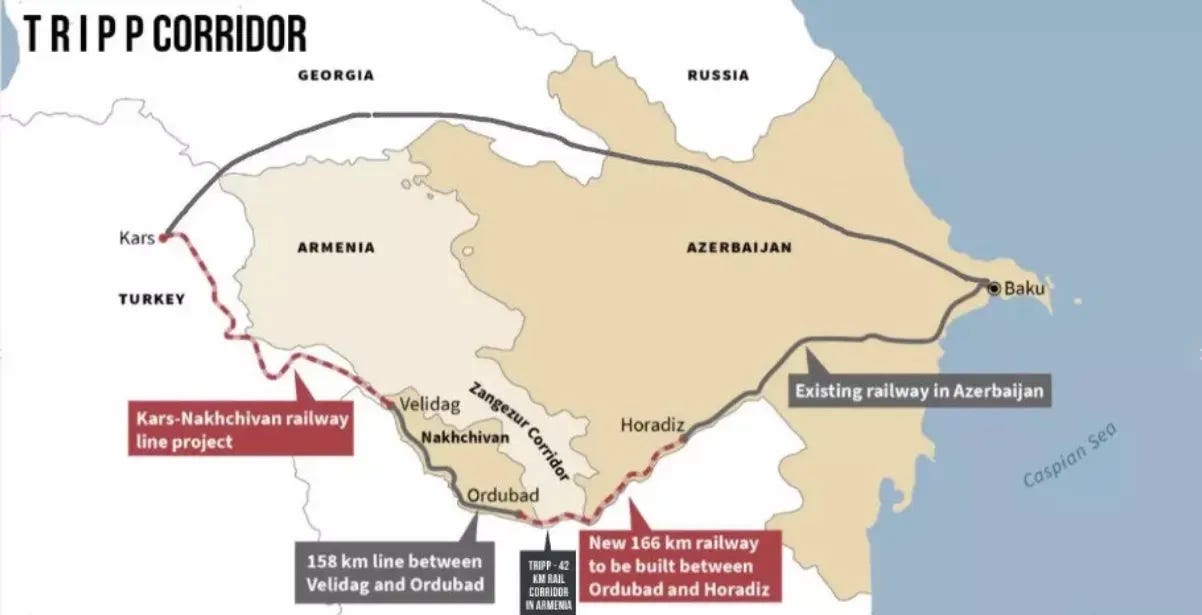
A $200 million U.S. enterprise fund managed through the State Department will facilitate grants and loans to underwrite TRIPP. It’s slated to launch new rail transportation along a 26-mile corridor connecting existing rail and seaport points, and to tap strategic minerals and an expanding energy and digital infrastructure, including data centers. Under Armenian law, the United States will sublease the land with a consortium of developers and management under a 99-year lease. According to Armenian press accounts, another $400 million in U.S. foreign aid could be designated for the project. Completion date: 2028, before President Trump leaves office.
It’s perhaps worth noting here that neither Armenia nor Azerbaijan have had a Senate-confirmed ambassador since the Biden era.
Last week the State Department named Konstantin Sokolov chairman of the TRIPP fund. A Russian-born private equity investor living in Chicago, Sokolov has given $11 million to MAGA, Inc., making him one of the biggest donors to Trump-linked groups. Sokolov is also one of 36 donors contributing over $350 million to the president’s ballroom project.
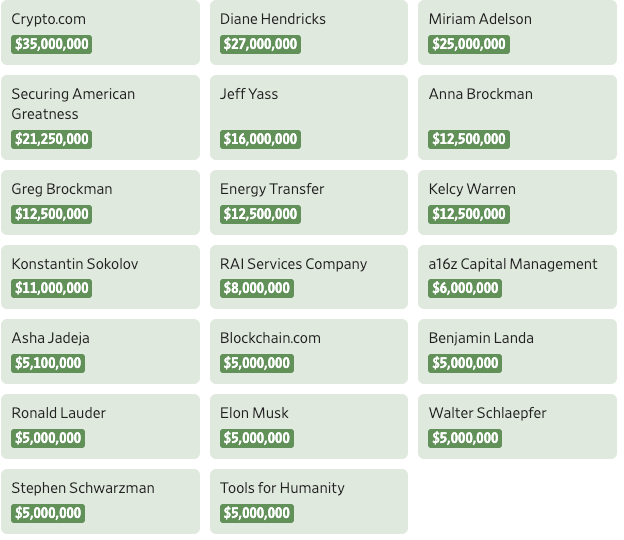
Sokolov has an investment portfolio focused overseas on telecommunications, energy, data infrastructure, and critical minerals. In Armenia he has picked up investments Russia was forced to sell off due to sanctions following the 2022 invasion of Ukraine. As a result, he owns 20 percent of Viva Armenia, the country’s largest telecom. And just last week Russia’s state-owned VTB Bank sold to Sokolov its stake in Teghut copper and molybdenum mine, one of Armenia’s largest private entities.
Putting a business operator, not a career bureaucrat, in charge of an infrastructure campaign like TRIPP can be valuable. But that’s less the issue here than the priorities and guardrails around these arrangements. It’s whether Sokolov and Trump donors like him are shaping public policy around personal private interests. It’s about who holds them accountable for executing business deals under the guise of U.S. foreign policy and diplomacy.
Other news:
War in Iran is now a wider war than the one the United States hoped to bring to a close with a June 17 MOU. The Iran-backed Houthis say they will impose a blockade on the Red Sea, choking Saudi Arabia’s oil and other supplies. At least two U.S. soldiers have been killed, one missing, and dozens wounded in an attack on a base in Jordan—all as Iran carries out retaliatory strikes in the midst of 9 days of U.S. bombing targets inside Iran.
Off the coast of Myanmar, at least 500 Rohingya refugees are believed dead after boats carrying them capsized in the Andaman Sea. A Muslim minority once residing in Myanmar’s Rakhine state, a million Rohingya have survived only by living in overcrowded camps in Bangladesh now subject to monsoon rains and funding shortages.
In China, authorities earlier this month unexpectedly released from 8 months in jail Ezra Jin Mingri, senior pastor of Zion Church. Jin was flown to Los Angeles, where he reunited with his wife and children. The release apparently came after President Trump raised the pastor’s case in a meeting with Chinese President Xi Jinping. For the eight pastors and Zion Church staff who remain in prison, and their families, the days are filled with worry.
Countries bordering the Democratic Republic of the Congo have stepped up screening as health officials say the months’ long Ebola outbreak continues to outrun medical response. At least 930 people have died of the illness in DRC with 2,344 cases, but WHO officials warn the number could be up to four times higher.
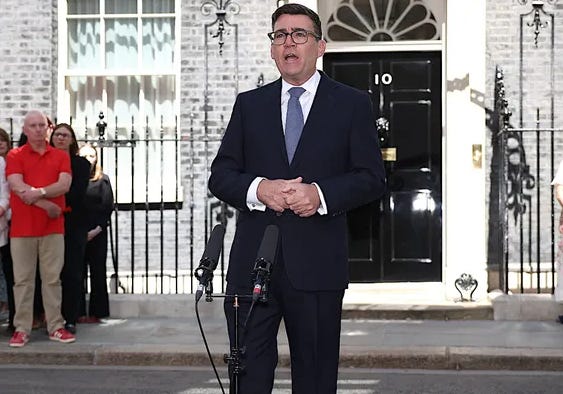
The United Kingdom today has a new prime minister, its sixth in under a decade. Andy Burnham, until recently the mayor of Manchester, replaces Keir Starmer as Labour Party head in an increasingly fragmented British political scene.
With Spain’s 1-0 victory over Argentina in yesterday’s World Cup final, hat’s off to the writer/editor who thought it was a good idea to interview Lamine Yamal’s grandmother.
On the homefront, leave it to an experienced journalist like Jon Ward to give us the retrospective on Sen. Lindsey Graham we need. Graham died last week at 71.
And finally: “You cannot get away from your own humanity. I have learned that especially over time, to be a vulnerable human even in the midst of covering very vulnerable people.”
I said that in a rambling sort of interview I did for Zenger House last year, covering a 2025 story on Congo’s crisis of rape in the midst of war. I’d forgotten, but I’m grateful to see it posted this week because somehow it talked back to me in a timely way.
It’s a window on why I keep coming back to GlobeTrot (and maybe you should too) when the news of any week breaks your heart and scalds your brain. What can draw me, or any of us, to faraway places and difficult stories?—
One is that it is different. Your eyes are open just as mine were on this reporting trip, in so many ways that you cannot possibly know until you are actually there. It feels like such a privilege to be able to step into a life, step into someone’s kitchen, have them make you a meal, eat food you have never dreamed of tasting before. Those are all the things that are exciting about it. There are so many dimensions to that.
The other side of that is that it is the same. Over and over and over again, you see how our humanity binds us together. … I could relate as I watched these women walk who had just come out of surgery in this ward and watched them coming alongside one another and holding one another by the elbow … If you have had a baby, you start to feel that in your actual body … You begin to relate to these people as people and feel like this could be my neighbor, this could be my sister, this could be my daughter.
Thank you for linking to the interview!