Finding a common joy
What a little rebuilding in a war zone can do

This morning I spoke to Maria Acetoso, an architect with UNESCO currently working in Ukraine. Before leading the UN agency’s culture unit there, she worked for almost six years in Iraq, managing UNESCO’s project to rebuild key monuments in Mosul’s historic Old City. I visited those sites last month and am completing a story on the city’s revival (to be published by The Dispatch).
One of the main projects, completed in January this year, is the Al-Hadba Minaret, a 50-meter prayer tower first built in 1172. Over time it developed an iconic lean that made it emblematic across the Muslim world. Its significance, said Acetosa, is like the Eiffel Tower for Parisians or the Leaning Tower of Pisa for Italians.
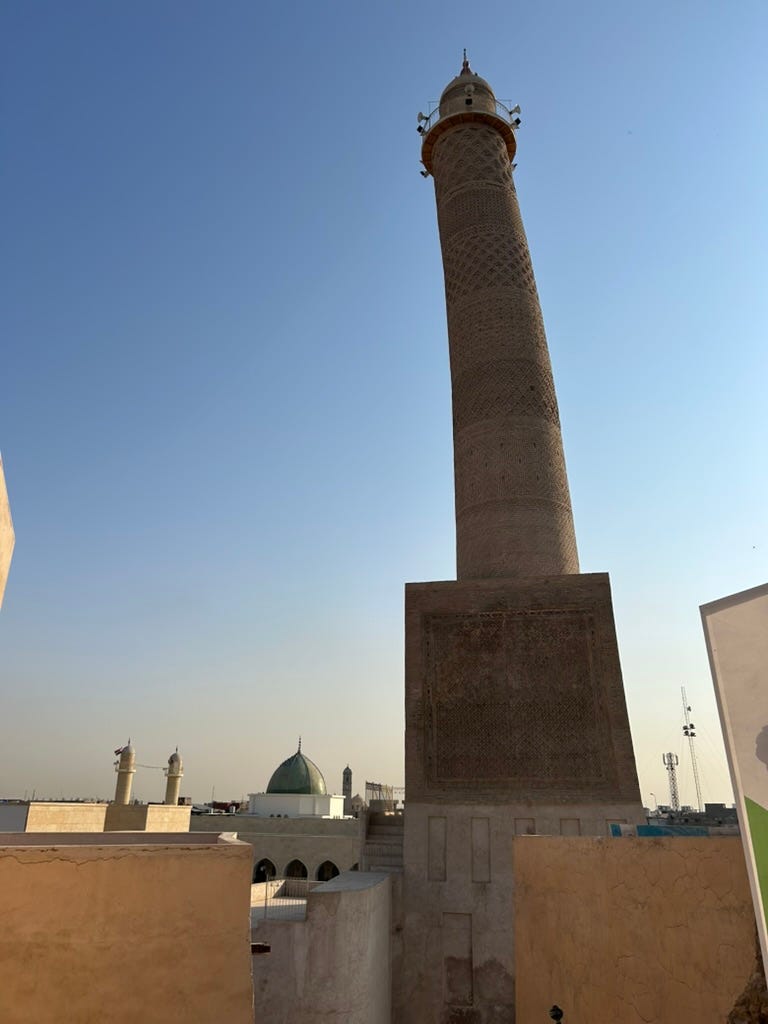
ISIS militants blew up Al-Hadba in 2017, and it was a pile of rubble when Acetoso arrived in 2019. “When I started touring the site, I had a Moslawi engineer who had been there throughout the [three-year ISIS] occupation. He and others were telling me constantly, ‘We will never manage to repair the minaret. The minaret can never be rebuilt.’ This was an expression of the loss of hope. Everywhere I turned, there was no hope in the community.”
Even in a place unscarred by war, even here in the United States, we lose hope when we see so much breakdown. This year like never before Americans feel the breakdown of institutions and the loss of community cohesion we once took for granted. We sense that our voice no longer matters. We feel powerless.
But then: “What I saw over time was that the more we were working, the more the team got engaged in the reconstruction of something that was so meaningful, their thinking progressed,” says Acetoso, “and gradually they had the idea, ‘Oh, maybe there is a chance.’”
When the minaret started going up, Acetoso says it radically changed everything. Not only the workers but the whole community was invested. On the day the rebuilt Al-Hadba was completed, people came from all over to take pictures. As they were posted on social media, Acetoso said she was bombarded with messages from colleagues all over the world.
“It was a common joy.”
Many of us at year’s end feel a hopelessness about American life as political leaders turn every challenge into an opportunity for division. This week, typefaces at the State Department website!
I’m challenged by the resilience and kindness (her words) Acetoso saw in Mosul, something I echo from years of watching Iraqis endure war and injustice. It reminds me of a colleague-friend who pointed out recently that Christianity is meant to flourish on the margins (and evidently gets corrupted moving away from them). Its central story is one of utter powerlessness, and of survival against all odds. And of finding ways to build, again and again, out of a rubble-strewn landscape.
Other news:
Syria on Monday marked one year since the fall of the iron-fisted Assad regime, overthrown by Syria’s new president, Ahmed al-Sharaa, after his Islamist group Hayat Tahrir al-Sham seized Damascus.
Sharaa marked the occasion by performing dawn prayers at Umayyad Mosque in Damascus, dressed in military fatigues like those he wore during the victorious HTS campaign.
Attacks on non-Muslims since Sharaa took over compound fears of an uncertain future, even as a new openness is drawing Syrians toward the work of churches.
“Everyone here now is living a contradiction,” Nahla Ishak said. “We’re happy that the corruption, the original problems, and the domination of [the previous regime] are gone, but we don’t know what the future will do to us.”
In Gaza, Winter Storm Byron brought flooding to tent camps, exposing devastating humanitarian gaps that left at least one 8-month-old dead of exposure.
Three U.S. doctors and a nurse say Israel has prevented them from returning to work in Gaza, despite experience there and a U.S.-backed peace plan that pledged a surge of humanitarian assistance.
In Lebanon a Catholic priest and a Muslim librarian find common ground in working to de-radicalize prisoners. “Kill them with kindness,” Maya Yamout said, “and kindness will prevail.”
The former President of Iraq Barham Salih reportedly has been chosen to lead the UN Refugee Agency, a sharp break for a post that has been dominated by European nationals since its founding after World War II.
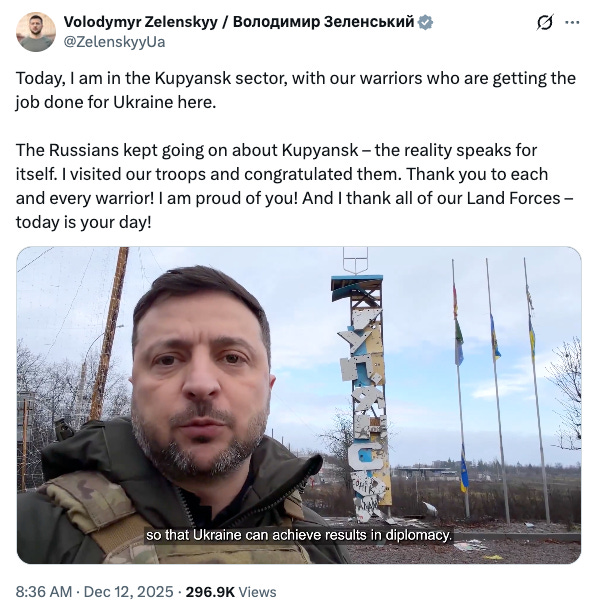
Today in Ukraine, President Volodymyr Zelensky visited Kupiansk, a logistics hub near the hard-hit city of Kharkiv where Ukrainian forces have surrounded Russian troops and are retaking key territory. Last month Russian General Staff Chief Valery Gerasimov claimed that Russian forces had captured Kupiansk. In a video recorded there, Zelensky said, “It’s extremely important to achieve results on the front so that Ukraine can achieve results in diplomacy.”
Ukraine is pushing back against a U.S. peace plan, vowing it will not hand over territory to Russia and demanding legal guarantees of protection against future aggression from Moscow.
The European coalition supporting Zelensky had a challenging week east and west. The new National Security Strategy issued by the White House paints the European Union as a bigger threat to the United States than Russia or China, and says immigrants and progressive social policies risk its “civilizational erasure.” The verdict appears an attempt to divide the continent further—
“What [Europeans are] getting from Trump is the strategy of maximum polarization that hollows out the center,” said Will Marshall from the Progressive Policy Institute. “The old established parties of left and right that dominated the post war era have gotten weaker,” he said. “The nationalist or populist right’s revolt is against them.”
A hostile U.S. stance toward Europe opens the door to incursions from Russia and others. The British Navy tracked a Russian submarine in the English Channel for three days, and the UK’s defense minister said hostile intelligence activity is up 50 percent—chiefly from Iran, China, and Russia.
Experts warn the new Trump strategy is a short-sighted “America First” blueprint that trades democracy for pragmatic, economic self-interest.
Venezuela opposition leader Maria Corina Machado made a harrowing escape by water from her home country, where she’s been forced into hiding, but just missed accepting her Nobel Peace Prize in person in Norway on Wednesday.
Hong Kong media tycoon Jimmy Lai spent his 78th birthday on Monday in a prison cell in Hong Kong, where he’s been in solitary confinement for the last five years. This coming Monday he’s likely to find himself in a courtroom, where authorities say he will be sentenced for sedition and other activities stemming from what could be called the crime of “committing journalism.”
Weekend long read: With the State Department’s war on fonts, or typefaces, I was reminded of this story about one of the most beautiful serif typefaces in the world, the century-old Doves Type, and its unlikely rescue by salvage divers from the River Thames in London in 2014. The BBC has great visuals in this presentation too.
I’ll be taking a short break from Globe Trot for Christmas, returning in 2026. Merry Christmas and happy new year!
Your insights and observations offer us a blueprint for maintaining and regaining hope. Thank you for naming the challenges we witness and possible outcomes we can co create.
So grateful for your keen insights, Mindy- such a precious gift of sense-making and standing together in this both awful and wonderful world.