Crossing deep water
On Minnesota, Syria, Iran, Cuba, and launching out anyway

The night before I was to take a ferry across Lake Kivu, I couldn’t sleep so I decided to read about it. When I had planned this first reporting trip to the Democratic Republic of Congo, I needed transport from the city of Goma at the lake’s north end to Bukavu at its southern tip. My friend Nik said, “Don’t drive. You have to take the ferry to feel the place.”
Kivu’s water stretched dark and still below my hotel room balcony, and by the light of my laptop I read about exploding lakes. Lake Kivu is one of three in the world, subject to what geologists call limnic eruptions that occur once every thousand years or so. Chemicals at the lake’s bottom, in Kivu’s case methane and carbon dioxide, trigger these “outgassing events” and geologists find evidence of “massive local extinctions” about every millennium. Should one occur, say while I am late-night reading, it would endanger millions of people.
Taking the long drive over bad roads was at that point out of the question. I was awake awhile, picturing my lone self perched in the heart of Africa’s Great Lakes region and on the knife’s edge of war.
Less than six months later, a rebel army would capture Goma. Why wouldn’t an exploding lake explode? I thought. Kivu’s chemically charged waters stretched silent before me, 30 miles across and 30 miles wide and in some places a third of a mile deep. I had to cross it, and the next day I did (see below). As hundreds of Africans do every day.
That feeling, of sitting atop a waiting volcano, its immensity stretching in every direction, its hazards well beyond my imagination let alone control, is how I feel this week. It’s how I suspect many of us feel. We don’t know how near or far or deep down the next explosion will be. There is not only a geological compass charting how the world is shifting, there is a moral compass as well, and it is the moral compass we sense is listing.
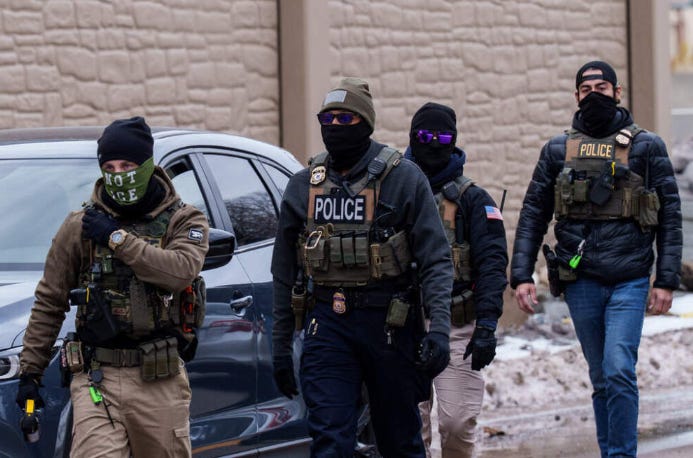
Minnesotans aren’t breathing a sigh of relief, despite the removal this week of Border Patrol commander Greg Bovino and pledges by White House border czar Tom Homan to work more closely with local authorities to move toward a drawdown of Immigration and Customs Enforcement (ICE) agents from the streets. Sixty days into an enforcement operation, with two daytime, close-range shooting deaths of residents at the hands of ICE agents, the ongoing risks to many vulnerable people are keeping tensions high and organized protests alive.
Top policing experts said the shooting of Minnesotan Alex Pretti appeared unnecessary and that federal immigration officers in Minneapolis appear “obviously overwhelmed and poorly trained and inexperienced.”
Despite Homeland Security rhetoric about detaining “the worst of the worst,” government data shows the number of detainees with criminal convictions is falling, meaning that nearly three-fourths of those in ICE detention nationwide do not have a criminal record.
In January, nearly 43% of those detained had no convictions or charges, according to publicly available ICE data.
Meanwhile, the percentage of those arrested by ICE who have criminal convictions — not merely pending charges — fell from 44.7% in Trump’s first three months to 31.8% in the three months ending in mid-October.
On risks to children, school leaders and lawmakers are worried about the health of 5-year-old preschooler Liam Conejo Ramos, who remains in detention along with his father after they were taken by ICE agents and transferred to Texas on Jan. 20. The father has no criminal record, and the family, originally from Ecuador, had an active asylum case. Liam, who reportedly had a fever the day of his arrest, appeared lethargic during a visit with members of Congress. Two other students were being held in the same facility with their parents, according to district school officials.

On risks to Native Americans, this month ICE detained four Oglala Sioux tribal members in a Minneapolis sweep, while others have been stopped and harassed, leading to a nationwide effort by Native American leaders to issue tribal IDs. About 50,000 Native Americans live in the Twin Cities, and like others are protected by tribal treaties that establish tribal sovereignty as “domestic dependent nations” under federal law. It should go without saying—
“As the first people of this land, there’s no reason why Native Americans should have their citizenship questioned,” said Jaqueline De León, a senior staff attorney with the nonprofit Native American Rights Fund and member of Isleta Pueblo.
Thousands of refugees, many of them persecuted Christians, have found a safe haven in Minnesota. But for weeks now, many of them have not left their homes on advice of their lawyers and local refugee-resettlement agencies after at least 100 refugees were arrested by ICE agents, reports Christianity Today. A federal district judge on Wednesday issued a temporary restraining order barring further arrests and “unlawful detention” of refugees in Minneapolis, but for many a sense of safety found in the U.S. has been shattered.
Ecuador lodged a formal diplomatic protest with the United States after an ICE agent attempted to enter the country’s consulate in Minneapolis without permission on Tuesday morning.
Additional reading:
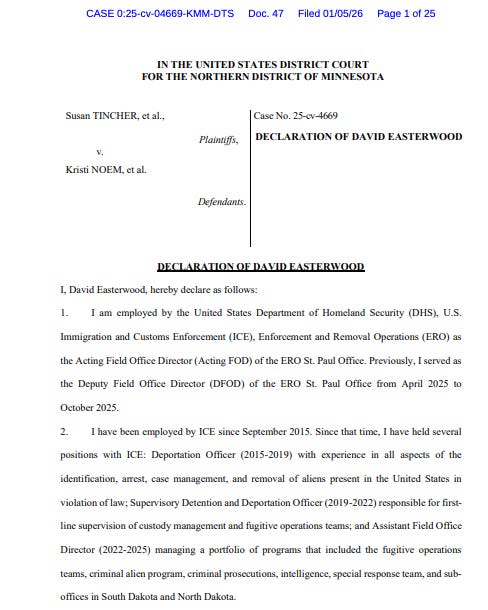
A court declaration filed by David Easterwood, a pastor at Cities Church in St. Paul, contains detailed background on enforcement and removal operations and DHS use of force policy. Protesters disrupted a Sunday service at the church Jan. 18 over Easterwood’s directing ICE enforcement efforts in the wake of the killing of Renee Good. To date, a federal probe into the protests has led to four of the protesters being arrested and charged, the latest being journalist-provocateur Don Lemon arrested today. At the same time, no arrests or investigation reports from federal agencies have been forthcoming in the deaths of Good and Pretti.
Catholic leaders in the U.S. issued a statement on Jan. 28 critical of deaths stemming from ICE operations, saying “the current climate of fear and polarization, which thrives when human dignity is disregarded, does not meet the standard set by Christ in the Gospel.”
Two former senior DHS officials, who served in the first Trump administration, write in The Denver Post that Trump ICE operations endanger the rule of law, civilians, and officers.
Let us be clear at the outset: we support strong borders and lawful immigration enforcement. Law enforcement deserves respect; society cannot function without it. But enforcement that treats the public as the enemy and abandons constitutional limits does not make us safer. It puts the entire system at risk — legally, operationally, and morally.
Chris Seiple, president emeritus of the Institute for Global Engagement, writes a personal reflection on meekness and humility, “the bridled power of the horse,” from time serving as a Marine.
Other news:
“I meant what I said,” Prime Minister Mark Carney of Canada told President Trump in a 30-minute phone call this week. Carney’s speech at the World Economic Forum in Davos, a call-to-arms for “middle powers” faced with U.S. coercion on trade, prompted Trump to threaten 100 percent tariffs on Canada over its trade deal with China. Carney is going ahead and the Canadian dollar moved higher as traders, and world leaders, find ways to counter U.S. threats.
Syria reached a formal ceasefire agreement today with Kurdish forces in its northeast allowing forces under President Ahmed al-Sharaa to take control. The region, a semi-autonomous area, is governed by a coalition of Arab, Christian, and Kurdish parties. The agreement calls for phased integration of Kurdish forces into the Syrian army as it takes control of the region and key border crossings to Turkey and Iraq.
Earlier in the week Trump congratulated al-Sharaa by phone for the government attack on Syrian Democratic Forces—the Kurdish-led army that worked alongside U.S. forces to battle ISIS and whose local control led to the terror group’s defeat in 2019. The government’s offensive led to heavy fighting and mass displacement. Locals are wary of Trump’s embrace of al-Sharaa, who traveled to Moscow to meet with Russian President Vladimir Putin a day after the phone call. Putin wants to keep bases in Syria, a longtime Cold War ally.
“Now the test is protection: no abuses, no displacement, no intimidation of civilians. The U.S. & int’l community must set clear benchmarks & monitor compliance,” said Nadine Maenza, the former chair of the U.S. Commission on International Religious Freedom with long experience in the region, in a post on X.
Iran is offering incentives to conscripts and ruled out talks today with the United States after Trump threatened to strike the country. “Just as we are ready for negotiations, we are ready for warfare,” said foreign minister Abbas Araghchi. Genocide prosecutor Payam Akhavan, an Iranian-born Canadian lawyer, said he believed more than 10,000 Iranians had been killed by regime forces in under a month of unrest in Iran, as part of a staggering crackdown on protests.
Cuba faces additional lines at gas pumps and food shortages as Trump on Thursday signed an executive order declaring Cuba an “unusual and extraordinary threat” to U.S. national security. Trump threatened new tariffs on oil suppliers. In congressional testimony Wednesday, Secretary of State Marco Rubio said when asked about forcing upheaval in Cuba, “I think we would like to see that regime change.”
Ukraine heads into the weekend in a cat-mouse diplomatic standoff with Russia after Putin agreed to hold off attacking Kyiv—until Sunday. Meantime, a frontline correspondent rescued a 4 year old girl from the upper floors of his own apartment building in Kyiv when it was struck by a Russian drone on Jan. 28. The girl’s mother and partner died in the attack. Radio Liberty reporter Marian Kushnir, wounded once already in the war, said:
“The girl, when I took her out, she started crying a lot, and then she started shaking a lot, she hugged me. And then it hurt me a lot. In 10 years of war, I have never had such feelings as now, holding a four-year-old child in my arms who is crying, realizing that her mother is dead.”
Today President Trump named Kevin Warsh to be the next chairman of the Federal Reserve, choosing a former Fed official who has aligned himself with the president’s criticism of the central bank.
Back to my reporting from Congo and the article on the toll of its 30-year war, reader Jana Gillham this week had a novel suggestion:
So, what if on the first day of the month, at 9:00 a.m. you turned off your cellphone (all the way off) for 6 minutes to call attention to cobalt supply chain humanitarian issues?
And I want to say that even under less-than-the-best conditions, there is a privilege to travel, to launching out in a boat across unknown waters to an unknown place, taking cold showers and drinking bad coffee, and simply moving through the reality that not everyone in the world does life as we do it, or can. That’s our reality (and maybe why you’re here). On most days I believe, even when I doubt, God who made the world can handle it.
Always lots of information we are not hearing anywhere else. Thanks
It was great to hear you on The Dispatch Roundtable. Your voice is needed.